Monday, 24 June 2013

Busy times

Life continues to be busy and will no doubt remain so during my last few weeks here.  It has been great to have visits from three sets of VSO volunteers over the past month or so.  They have all been very impressed with our accommodation at Haramaya (having a hob and an oven is a definite luxury in Ethiopia!) and have enjoyed visiting the colourful city of Harar.  I am really looking forward to my sister and her boyfriend visiting in a couple of weeks.  It will be lovely to show them what I have been doing over the past few months and to explore the sights of northern Ethiopia together. 

Helen and I continue to have weekly Amharic lessons and have even begun to master the past and future tenses.  Knowing a small amount of the language has certainly helped with day-to-day activities and seems to impress the locals.  My daily 10 minute walk to and from the hospital includes a chat with several people – there aren’t many ‘ferengi’ (white people) in Harar so after nine months I remain somewhat fascinating!  I often buy bread for lunch from a small kiosk near the hospital and bananas from a lady who has a stall next to the hospital gate.  I’m certainly going to miss being able to buy a kilo of mangos for 50 pence when I get back to the UK!

A well-stocked corner shop!
Bananas at the hospital gate
 
The paediatric ward at the hospital remains full and there are still mattresses lining the main corridor.  Many children are admitted with malnutrition or have diseases such as TB meningitis and rheumatic fever which have largely been eradicated at home.  There has been a recent measles outbreak with many children presenting with severe complications, perhaps useful experience for my return to the UK…  The number of babies with congenital anomalies is also really striking.  Over the past couple of weeks I have seen a baby with a cervical meningocoele (a protrusion of the fluid surrounding the spinal cord from the back of the neck) and two babies with encephalocoeles (a protrusion of the brain from the skull). 
 
Mattresses line the corridor in the Paediatric Ward
A couple of weeks ago I saw a five month old baby who was admitted to the Neonatal Unit back in January with severe breathing problems.  He had some immunisations at the hospital last week so his parents brought him to see me.  It was really lovely to see that he is thriving and developing well.  I was also very pleased that two babies stayed to complete three week courses of antibiotic treatment for meningitis and another premature baby weighing 1.4kg has been receiving Kangaroo Mother Care over the past ten days.  The neonatal nurses are becoming more involved in the monitoring and care of the babies, and I am sure that this helps in encouraging the families to stay to complete treatment.

I continue to teach the 4th and 5th year medical students, and helped to assess the 5th year medical student clinical exams last week.  I’ve also completed the evidence-based neonatal clinical guidelines which provide an operating framework for the neonatal unit as well as guidance on the management of common neonatal conditions.  The guidelines were printed on Friday ready for introduction and implementation this week. 

Medical record-keeping is an area in which practice could certainly be improved at Hiwot Fana and was identified as a major weakness in the care of the two surgical cases that I reviewed recently.  Together with a colleague, I have recently audited the standard of recordkeeping across the hospital and developed a two hour training session about medical documentation.  We delivered the training to 24 medical interns last week and will assess the impact in a month or so.  The interns are working really hard currently (night duty every two to three days in addition to normal working hours) as half of the group are completing community-based attachments.  I attended the final presentations from the first group of community-based interns a couple of weeks ago.  It was interesting to hear how they have been identifying ways in which they can improve health outcomes (such as improving attendance at antenatal clinics and administration of vitamin K to newborn babies) and have been delivering health education to various target groups.

I really enjoyed my trip to Addis for the VSO Leaver’s Workshop at the end of May.  It was great to catch up with several other VSO volunteers as well as a couple of friends from Haramaya who are now living in Addis.  A change of diet and a glass or two of decent chilled white wine were very welcome too!  I also had my first set of blood tests for viruses after my needlestick injury and was really relieved to know that everything was negative.  I’ll have another set of blood tests in August.  I flew to Addis again today for a workshop reviewing the VSO Child Health Programme in Ethiopia.  Currently there is no funding to replace me or the other two VSO Paediatricians who leave in August.  The workshop will be attended by representatives from the Ministry of Health and UNICEF, and I have been asked to present my experiences and to discuss the case for ongoing funding.

I’ll be in touch again soon with more news and photos.


Sunday, 12 May 2013

Warmer babies and a weekend in Awash

Time is flying by here and it is now only about three months until I plan to return to the UK, ready to start work back in Bristol at the beginning of September. 

Life at the hospital has been really busy over the past couple of weeks.  The rain brings disease and has led to increased numbers of children requiring admission, including several with severe malaria.  One of the doctors kindly checked that I am taking my doxycycline properly!  The number of admissions has exceeded bed capacity so cots and mattresses line the main corridor on the paediatric ward.  The 4th year medical students had their clinical exams last week so we spent three days assessing their history-taking and examination skills.  The increased workload, together with staff shortages, has meant that I have found it hard to escape from the ward to work on other projects.  Amongst other things, I plan to work with the Head of Paediatrics to develop standards of paediatric care and basic neonatal management guidelines.  I hope that I will have more time to work on this over the coming week.
It has been great to see that some of the changes (medication charts, neonatal monitoring charts, neonatal referral forms) that I have introduced at the hospital have become part of routine care and I hope that this will remain the case long after I have left Ethiopia.  I have also been really encouraged by the results of a repeat audit of neonatal temperatures.  You may remember that when I arrived I was really struck by the number of hypothermic (cold) babies on the Neonatal Ward.  I decided to undertake an audit of the temperature of the babies on the daily ward round over a two week period and found that 49% had a low body temperature.  Following this, I raised awareness of the dangers of hypothermia by training the nurses and medical interns, arranged for repair of the overhead heater and wrote a guideline about managing hypothermia which was translated into Amharic.  I have been reinforcing good practice on ward rounds, including making sure every baby is given a hat to wear and that we use Kangaroo Mother Care whenever possible.  I recently re-audited the body temperatures of the babies and was really pleased to find that there was a significant reduction in the number of cold babies - decreased from 49% to 23%.  The number of very cold babies (temperature less than 35C) had reduced from 22% to 2%.  I am really pleased with these results and will present my findings to a departmental meeting soon.  It is clearly vital that the good practice continues and I will encourage the doctors to identify other areas where audit could be used as a driver for change.

Improved patient monitoring: one of the medical interns records the vital signs of a baby
Another way in which I have highlighted areas for improvement in clinical care is through individual case review.  I recently presented the cases of two babies with bowel obstruction to a joint paediatric and surgical meeting.  Both babies died after their operations, one after two days and one after eight days.  After the deaths, the local surgeon said he that was reluctant to operate on any more babies as he had concerns about the way that they were looked after post-operatively.  I suggested that we looked at the two cases in detail to identify what was done well and what could be improved.   The presentation was well received and it was great to see local doctors identifying gaps in clinical care and making suggestions as to how practice could be improved.  Poor documentation was a consistent theme and I plan to develop a training session for junior medical staff across the hospital about the importance of recording the care that they deliver.
Helen and I are now the only VSO volunteers at Haramaya University but feel well supported by our Ethiopian friends and colleagues.  My salad leaf, basil and coriander seeds have grown well on the balcony and I have been enjoying the fresh produce over the past week.  It was ‘Fasika’ (Ethiopian Easter) last weekend so Helen and I took advantage of the public holiday and spent three nights in Awash National Park which lies about 300km along the road to Addis.  The park takes its name from the Awash River which forms a series of beautiful waterfalls as it flows into a deep gorge.  The gorge then carves through the savannah landscape and reaches a depth of 150 metres in places.  We stayed at a lodge overlooking the falls – the dining area was positioned such that you could watch crocodiles basking on the rocks in the river below.  We were very lucky to meet some expats who had their own vehicle and invited us to join them on a couple of game drives and a trip to Mount Fantelle, a nearby dormant volcano.  Although there are reported to be large mammals in the park, it is rare to see any of the ‘big five’.  The area is rich in birdlife and the park is reported to be home to 450 species.  We saw dik-dik, gazelle, oryx and baboons on an early-morning game drive and spent a very pleasant evening watching hyenas and warthog leaving their den to go out to hunt.  Last Sunday morning I climbed about 1000m to the top of Mount Fantelle and was rewarded with stunning views of the surrounding Rift Valley and a 350m deep crater ‘lake’.

The entrance to Awash Falls Lodge
 
Enjoying the view over the waterfalls

Hyenas and a warthog go out to hunt at dusk

A crack created by previous eruption of Mount Fantelle
 
View over Lake Beseka from the top of the volcano - it was a steep climb!
 
The reach of the mobile phone - overlooking the crater at the top of the volcano

I will travel to Addis in a couple of weeks for a VSO ‘leavers workshop’ and am looking forward to catching up with some of the other volunteers.  I’ll be in touch again soon with more news from Ethiopia.

Sunday, 14 April 2013

Lake Langano, the Simien mountains and a little bit of work!

I have been back in Ethiopia for four weeks now and feel that I have settled back into the very different way of life.  The ‘short’ rains are supposed to come in March and April, and we certainly had some spectacular storms when I first returned.  Unfortunately (but perhaps not surprisingly) the storms bring long power cuts.  It has been much sunnier and less wet over the past week, and I have enjoyed several hours in the sunshine on the balcony this weekend.
 
It was really good to see Helen again when I arrived back in Addis Ababa – she had flown to the capital on the same day in order to travel to Lake Langano for the VSO-Ethiopia annual conference.  The timing of the conference was great for me as it provided a gentle transition back into life here.  It was lovely to catch up with the volunteers who arrived with me in September and also to meet new people.  It was good to learn about the work that others have been doing and reassuring to hear that other health volunteers are facing similar challenges to me.  The setting by the lakeside in the Rift Valley was very tranquil and I think everyone appreciated the chance to share experiences away from their placements.
 
Beachside at Lake Langano
I travelled back to Haramaya with Helen and had a weekend to settle in before returning to work.  I brought back quite an eclectic mix of things from the UK – stickers to help organise paperwork at work, a HDMI cable to connect our laptops to the television, a pan brush, an Easter chick-making kit for Helen, a chick biscuit cutter, a large fabric planter for the balcony (together with seeds and plastic spade!) and plenty of chorizo.  I think Helen enjoyed making the pom-pom chicks and we had fun decorating some Easter chick cookies.  My colleagues were quite bemused by the icing and silver balls!  The seeds have now germinated and I hope to be able to harvest some salad leaves in a couple of weeks.
Easter celebrations!
I was apprehensive about what I might find when I returned to the hospital but was really pleased to see that the neonatal monitoring charts and medication charts that I introduced are still being used.  The patients are certainly receiving closer observation than when I arrived, perhaps in part due to my influence but mainly because of the arrival of the medical interns about six months ago.  I have formulated an action plan for the next four months which includes re-auditing neonatal hypothermia and looking at neonatal outcomes again.  I will continue to teach the clinical medical students, and will deliver the neonatal lectures to the second half of the 4th year students.  Next week I plan to present the cases of two babies with bowel obstruction who died post-operatively to a joint paediatric and surgical meeting.  I will outline the ways in which I feel the care could have been improved and suggest strategies to achieve this. 
 
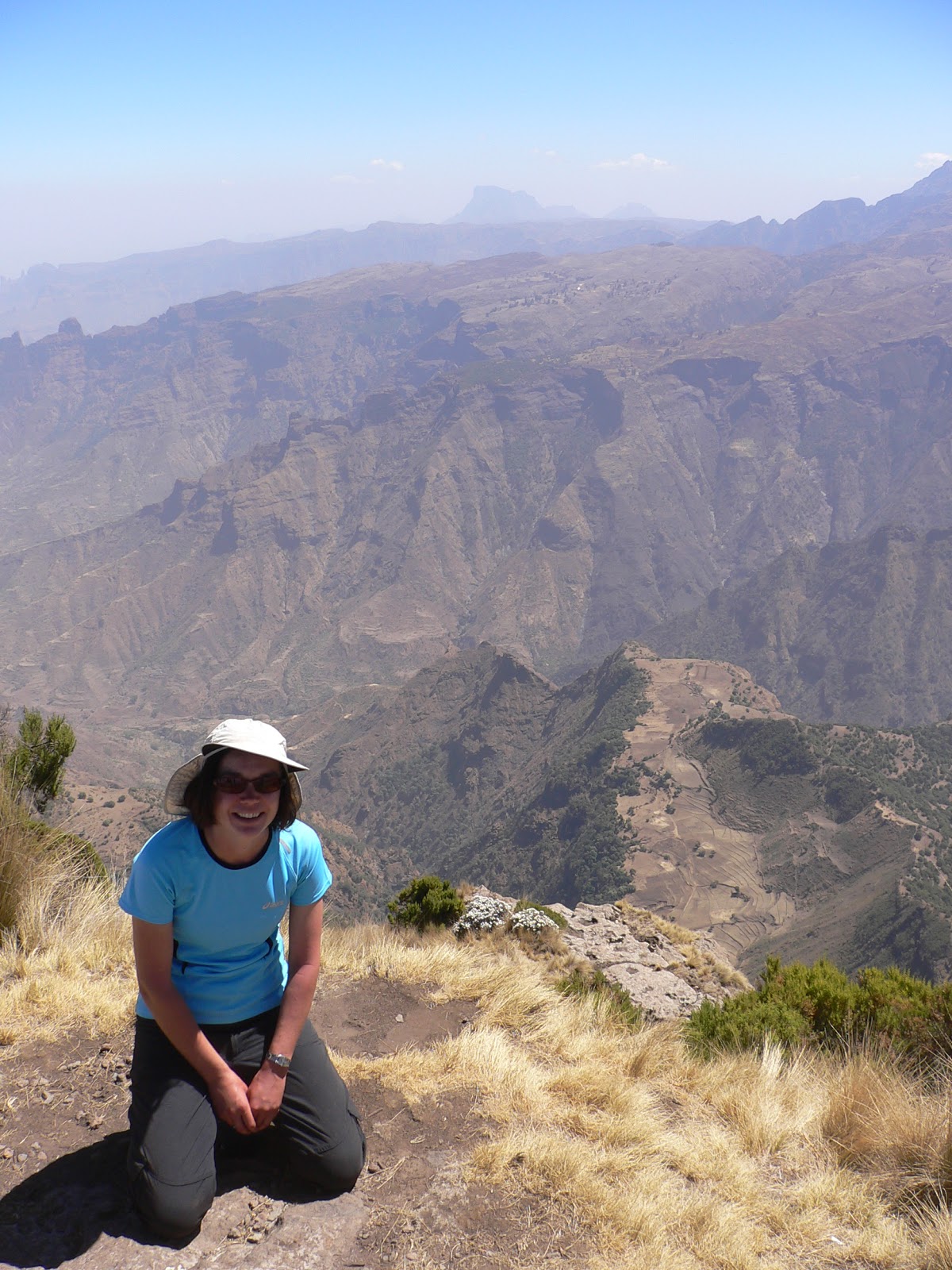
I spent just over a week at work before heading north for a three night trek in the Simien Mountains.  One of the other VSO volunteers had friends visiting from the UK so organised a trip and asked if I would like to join the group.  There were ten of us in total and we had a fantastic time.  I hadn’t realised just how spectacular the scenery would be and we were fortunate to see lots of gelada baboons, as well as the rarer Walia ibex and much rarer Ethiopian wolf.  We walked about 40km over three days along dramatic escarpments.  There are more than a dozen peaks over 4000m in the national park – we climbed to 4070m and luckily none of us suffered any significant effects of the altitude.  The nights were cold under canvas but the days were hot and sunny.  We all finished looking much browner than when we started, a healthy mixture of dirt and tan!

Dramatic rock formations

 
On top of the world!
Gelada baboons
Two Walia ibex (look closely!)
My focus has now returned to the hospital although Helen and I hope to have another trip away over Fasika (Ethiopian Easter) at the beginning of May.  I will be in touch again soon with news from Haramaya.

Thursday, 28 February 2013

It's chilly!


I find myself unexpectedly back in the UK having sustained a needlestick injury at the hospital a couple of weeks ago.  Unfortunately this has meant taking medication to reduce the very small risk of HIV transmission.  The medication can be associated with significant side effects and this, together with the need for a bit of emotional support, led to me returning home to complete the 28 day course of treatment.  Fortunately I have remained well and it has been lovely to catch up with family and friends.  I plan to return to Ethiopia in mid-March and will keep the blog updated with my progress.

Sunday, 3 February 2013

A very belated happy new year!

I apologise for the lack of a recent blog update - January was a busy month!

We had a very enjoyable Christmas Day complete with roast dinner, Christmas pudding and festive films.  Much to Helen’s delight, we were able to enjoy a second Christmas as Orthodox Christians celebrate the festival (‘Gena’ in Ethiopia) a couple of weeks after us.  We were invited to spend the day with one of Helen’s colleagues and his family, and were made to feel very welcome.  There was a very impressive spread of food and drink, and the family held a coffee ceremony after the meal.
Our Christmas dinner table - avocado, beef and tomato salad to start


Traditional coffee ceremony at Gena (Ethiopian Christmas)
My parents were in Ethiopia for much of January and we had a fantastic couple of weeks together. We spent a very enjoyable week exploring the south of the country and were very impressed by the diversity of people, scenery and wildlife. One of the highlights was a boat trip on Lake Chamo during which we saw hippos, crocodiles (at very close range!) and some beautiful birds. My lasting memory is being privileged enough to see a Hamer tribe bull-jumping ceremony. Bull-jumping ceremonies are important events in Hamer society and involve a naked male initiate being required to leap across about six bulls several times in order to prove his worth. If successful, he may then take a wife. I was initially unsure that I wanted to see such a ceremony as I was concerned that it may be a staged ‘show’ rather than an authentic celebration, and I had heard that the Hamer women were beaten as part of the proceedings. We were in fact the only farenji (white people) at the ceremony and, although some women were beaten, observing and understanding the context was very enlightening. The journey to the bull jump took us about 20km in our 4x4 vehicle across very arid countryside. We then walked for a further kilometre or so to a sandy riverbed where around thirty Hamer women were blowing horns, chanting and dancing with bells jangling around their calves. Many more men, women and children were gathered to watch the dancing. Some of the men’s faces were being painted and the women taunted these men to whip them across their backs. It was reassuring to see that the men were reluctant to do so but we learnt that the women perceived the whipping as demonstrating their strength and ability to be good wives. After an hour or so we walked with the tribe to a clearing where at least thirty bulls were gathered. The women continued dancing around the bulls before six animals were chosen and lined up for the initiate to leap over. I was struck by how healthy the tribespeople looked and it felt absolutely right that we were largely ignored during the ceremony. We left feeling very privileged to have gained a tiny glimpse into the lives of these people and our visit provoked much discussion about the future of such tribes.
Hippos...

beautiful birds...

and a very hungry-looking crocodile..!
Hamer tribe face-painting

Hamer women chant and dance
The bull jump
Mum and Dad returned with me to Harar where they spent a week exploring the city and visiting the hospital.  Dad’s Rotary Club had kindly donated some money to the paediatric ward which was used to buy some basic equipment (neonatal pulse oximeter, blood pressure monitor, ophthalmoscope/otoscope and thermometers).  It was great that my parents were able to deliver the equipment to the hospital and see it being used later in the week.  Visiting the hospital proved to be an emotive experience and it led us to discuss at length how best to support such institutions.  Money is certainly only part of the answer... 
Later in the week we had a very entertaining visit to the camel market in Babile, a town about an hour outside Harar.  The local people were very friendly and seemed intrigued by us – my ‘pop socks’ caused particular amusement!  At one point Dad was offered 99 camels in exchange for me but the negotiator made it clear that Mum was not wanted as part of the deal!
Camel market at Babile
I was sad to see Mum and Dad leave but there has been plenty to keep my busy at the hospital this week.  The fourth year medical students had their end of attachment exams so I was asked to prepare some questions for the written components, and spent three days examining long cases and the respiratory station of the OSCE (Objective Structured Clinical Examination).  The first group of medical interns will rotate to the Obstetric/Gynaecology Wards next week so I spent some time gathering their feedback on the paediatric attachment.  I was really pleased to hear that they have found the medication chart that I introduced to be very useful (previously there was no system for recording administration of drugs).  I was even more delighted to hear that the nurses are now asking for the charts to be filled in (the nurses initially seemed sceptical about their value) and that the interns would like to introduce the chart to the wards where they will rotate next.  Moments such as these certainly counterbalance the frustrations that I experience at other times.  I will be sad to see this group of interns leave – they have worked very hard and certainly bear hugely more responsibility than equivalently experienced junior doctors in the UK.
I have another couple of weeks at work before a friend visits from the UK.  I’m very much looking forward to seeing her and exploring the north of the country together – will need to dig out some warm layers for our trek in the Simien mountains, not had any need for such clothing so far!

Tuesday, 25 December 2012

Happy Christmas!!

Happy Christmas to you all!  Helen did a fantastic job of decorating our flat, which has now been nicknamed the 'grotto' and feels very festive.

Looking festive - the back of the bookcase makes a great fireplace!
Our Christmas celebrations got off to a great start on Saturday evening when Helen and I held a Christmas party, complete with a buffet, mulled wine and facepaints...


The fruits of our labour (with sparkle effect!)

Daisy wasn't sure about being a Christmas pudding... 

...but the boys enjoyed being big cats! 
We spent yesterday evening at Susie's flat and very much enjoyed a mince pie and (another!) glass of mulled wine whilst we opened our 'Secret Santa' presents.  Susie is cooking Christmas lunch today - we have managed to find a pork shoulder joint and a very small chicken to roast...  I've put together a quiz for later, and Helen and I have everything we need for the 'chocolate game'.  It will be a different Christmas but I am sure it will be full of fun and festive cheer!

I hope that you all have a very happy Christmas - I'll be in touch soon with more news from Ethiopia.


Sunday, 9 December 2012

Christmas is coming...

In many ways it doesn’t feel like December but Helen is compensating for the general absence of Christmas by making sure we have plenty of festive cheer in the flat.  Our bookcase has been turned around so that we can create a fireplace (!) and Helen has been busy making snowflakes and paperchains, photographs to follow...

Daisy, one of the VSO volunteers based in Dire Dawa, visited last weekend so we went on a tour of Harar’s old walled city.  Binyam, our guide, was very informative and expertly led us through some of the many narrow cobbled alleyways.  Around 30,000 people live in the 1 square kilometre walled city which contains over 80 mosques.  We visited the home of the 19th Century French poet, Rimbaud, as well as a traditional Harari house and a very peaceful Catholic church which sits on the same site as a school and orphanage.  I bought some of Harar’s famous coffee from the city’s small factory and have been enjoying it this week with milk from one of the farms on campus.


Showa Gate, one of the six entrances to the old walled city

Inside the walled city
 
Donkeys bring wood to the city


Local butcher...


View over the surrounding countryside

Another of the gates to the walled city


It was ‘Nations and Nationalities Day’ last Sunday so many of the university students dressed in traditional costume and took part in a parade on campus to celebrate the nine different regions of Ethiopia.  Later in the day Helen and I went for a walk with Gary, one of the other volunteers, through the eucalyptus forest on the edge of the vast university campus.

Students in traditional Harari costume take part in the nations and Nationalities parade


Sunday afternoon stroll with Helen
Life at the hospital continues to be busy.  I have now presented the findings of my short audit on the temperature of newborn babies, as well as the data I collected about admissions to the neonatal unit during October.  Keeping babies warm is a very simple but effective way of improving neonatal outcomes and an area of practice that I’m really keen to improve during my time here.  My audit showed that 49% of babies on the neonatal ward had a low body temperature.  I have now developed a guideline for temperature control in neonates which has been translated into Amharic, and I am encouraging staff to promote the use Kangaroo Mother Care (skin to skin contact of mother and baby) to keep babies warm.  I think the doctors were surprised by how high the neonatal mortality (28%) and self-discharge rates (44%) were during October.  The importance of regular monitoring of babies and effective communication with families (including managing expectations – the same all over the world!) cannot be overestimated.   I introduced a new observation and fluids/feeding chart to the neonatal unit last week and hope that this will help to improve monitoring of the babies.  I have also worked with one of the doctors to develop a prescription chart (currently medication orders are written in the medical notes and there is no documentation of drug administration) which we plan to introduce this week.

I have been really encouraged by the presence of the new medical interns on the ward and am sure that they will make a big difference to the quality of care given throughout the hospital.  I delivered a session on emergency paediatrics as part of their induction programme and included revision of the neonatal resuscitation that they were taught by Jo, the previous volunteer paediatrician.  I hope to run a similar session for the medical interns working on the maternity ward to try to improve the care that newborn babies receive.  I now spend two afternoons each week working with the interns in the paediatric admissions area so that I can share my skills in acute assessment and management, including the role of effective leadership and teamwork.  I also continue to enjoy my regular bedside teaching sessions with the 4th year medical students.
I will be in touch again with more news and photographs, including progress with the Christmas decorations!